








I am a theoretical ecologist interested in the principles that organise biological communities across scales of organisation. My work spans marine plankton, microbial ecology, and evolutionary theory, combining mathematical modelling with quantitative analysis of empirical data. A recurring theme is the role of stochasticity: how variability and fluctuations — demographic, environmental, or arising from ecological interactions — shape community structure and constrain evolutionary outcomes.
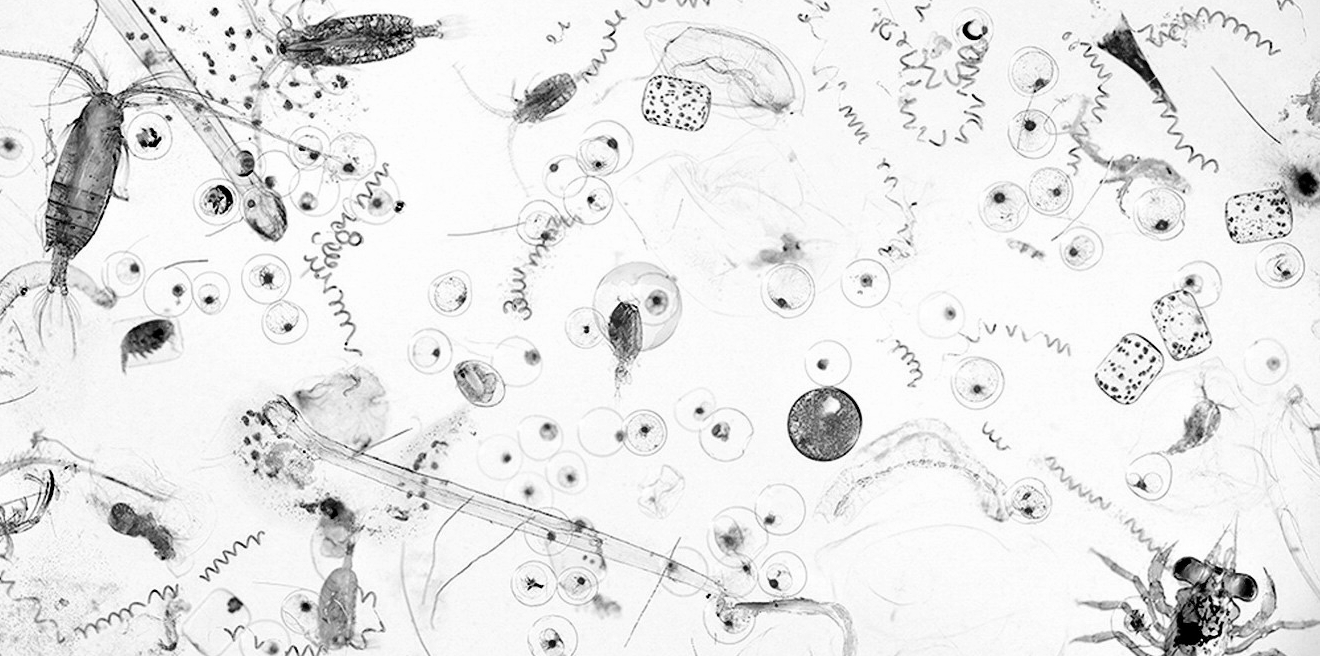
Plankton ecology: metabolism, interactions, and trophic structure
Plankton communities form the foundation of marine ecosystems and regulate a large fraction of global biogeochemical cycles, from primary production to carbon export. Despite their immense diversity, these microscopic organisms display strikingly regular ecological and metabolic patterns across environments and scales. My research explores how such collective behaviour emerges from the interactions between species, focusing on the links between metabolism, competition, and trophic structure in planktonic systems. Drawing on concepts from statistical physics and theoretical ecology, I investigate how simple interaction rules can generate robust large-scale patterns in biodiversity, productivity, and ecosystem functioning.
A central theme of my work is understanding how metabolism is shaped by ecological interactions rather than by species traits alone. In marine plankton communities, organisms compete for shared resources while simultaneously modifying the environment experienced by others. These feedbacks can regulate growth, respiration, and energy fluxes at the community level, often producing emergent scaling relationships that are remarkably consistent across species compositions and environmental conditions. By combining mathematical models with laboratory and observational data, I study how density dependence, competition, and trophic interactions influence the organisation of marine food webs and the functioning of ecosystems across levels of biological organisation.

Bacterial ecology: from growth to community dynamics and functional composition
Microbial communities are among the most diverse and functionally important biological systems on Earth, driving processes ranging from nutrient cycling and decomposition to host-associated metabolism and global biogeochemical regulation. My research investigates how ecological and evolutionary processes shape the structure of these communities, with a particular focus on the relationship between taxonomic diversity and functional organisation. A central question is why microbial assemblages with very different species compositions often maintain similar functional profiles, suggesting that ecosystem functioning may be governed by robust collective principles rather than by the identity of individual taxa alone.
To address these questions, I combine theoretical ecology with the analysis of large-scale metagenomic and environmental datasets. Using approaches inspired by statistical physics and complex systems theory, I study how interactions among microorganisms generate emergent community-level patterns, including functional redundancy, stability, and reproducibility across environments. My work explores how competition, metabolic constraints, and environmental filtering influence both taxonomic turnover and the conservation of functional traits, and how these processes affect the predictability of microbial ecosystems.

Stochastic processes and their impact on evolution
Ecological and evolutionary dynamics unfold in environments that are intrinsically variable. Population sizes fluctuate, interactions are noisy, and environmental conditions change across both space and time. My research focuses on how these stochastic processes influence evolution, not simply as sources of uncertainty but as fundamental drivers of ecological and evolutionary outcomes. In many systems, random fluctuations can alter selection pressures, promote coexistence, or even reverse the predictions of deterministic models. Understanding these effects is essential for explaining how biological strategies emerge and persist in realistic ecological settings.
I investigate how demographic and environmental variability shape the evolution of cooperation, dispersal, and life-history strategies. In particular, I study situations in which fluctuations modify the balance between competition and selection, generating evolutionary trajectories that cannot be predicted from average deterministic behaviour alone. This includes analysing how noise affects fixation probabilities, invasion dynamics, and the maintenance of diversity in finite populations. By combining analytical and numerical models my work aims to clarify the role of stochasticity as an organising principle in evolution and to understand how randomness contributes to the emergence of large-scale ecological and evolutionary patterns.